






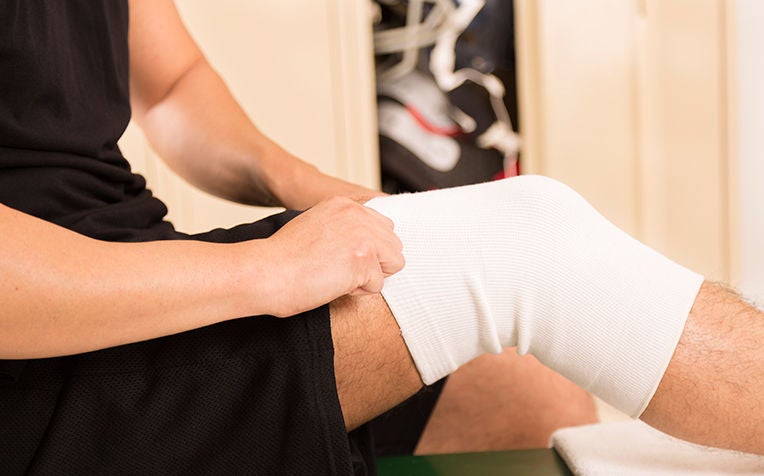
Ensure you choose the right knee brace for your type of injury.
There are braces for various joints such as the elbow, shoulder, knee, ankle, back and wrist. The most common braces are readily available from any pharmacy.
However, for more elaborate and specific braces, you will need to order online or purchase through medical supply companies. Some customised braces need to be prescribed by a doctor.
Types of braces used for lower limbs
Broadly, braces can be sub-divided into the following categories based on the intended purpose of the brace.
1. Prophylactic (preventive) braces
These are used to prevent injuries or to reduce the severity of injury during sports. There is limited evidence to support prophylactic use of braces.
2. Rehabilitation braces (immobiliser)
A doctor might prescribe a brace to an individual who has recently had injury or surgery. Such braces aim to protect the injured area whilst allowing a certain range of motion. The brace is usually worn for a period of time as instructed by the doctor. Rehabilitation (e.g. physiotherapy management with modalities and/or exercises) is usually commenced alongside the use of the rehabilitation brace.
3. Functional braces
These are used to support an unstable joint in a bid to prevent re-injury. For example, functional braces may be suitable for patients who have had an anterior cruciate ligament (ACL) tear or patients who have undergone ACL reconstruction and would like an external brace to protect the ACL graft whilst returning to sports.
A semi-rigid lace-up brace may be used for protection against recurrent ankle sprains during sports. For sports with more landing impact from jumps, a rigid (lace-up or stirrup) brace is more suitable. These braces will allow upward and downward movements of the ankle but will restrict inward or outward movements.
4. Other types of braces
The braces mentioned above mainly target to support joints with ligamentous injury. Other types of braces include:
Offload braces
An offload brace may be used for knee osteoarthritis predominantly present in one out of the three compartments of the knee. The brace may alleviate the pain or pressure associated with the degenerated compartment of the knee.
An offload walker may be prescribed by the attending doctor in the case of a bone, ligament or tendon injury in the ankle. It allows some weight-bearing whilst providing some support and protection for the injured tissues.
Patella tendon brace and patella stabiliser brace (patella refers to the knee cap bone)
A patella tendon brace (knee strap) is used to support and re-distribute the forces that go through the patella tendon. It’s commonly used for conditions such as “jumper’s knee”.
A patella stabiliser brace is used to reduce compression of the knee cap bone and to prevent it from excessively shifting outward. It’s commonly used for conditions such as anterior knee pain and patella subluxation/dislocation and patellofemoral pain syndrome.
Compression bandage, ankle guards, knee guards and arthropads
These are soft guards/sleeves with an elastic component. They are used to provide some compression and reduce swelling.
Who most likely requires an ankle or knee brace?
Generally, ligamentous injury to the knee occurs in people who either have had a fall or a twisting incident or are involved in sports that require jumping, landing, cutting or pivoting.
In Singapore, anterior cruciate ligament (ACL) injuries are most common in people who play soccer, basketball and netball. The typical age group of the people with ACL injuries is 18-30 years old.
Ankle sprains can occur to anyone. A person can be walking, miss a step and twist the ankle inwards, resulting in an ankle sprain. It is common in sports that require jumping and landing such as basketball and badminton.
Patellofemoral pain syndrome (runner's knee) commonly affects runners and people who participate in any sports that requires running. With the increased interest in marathon running, this condition is seen in a wider age group (15-40 years old).
Patella tendon pain is more common in athletes involved in jumping sports such as basketball.
Pros and cons of wearing braces during sports
The pros are:
- Increased stability
- Decreased pain
- Performance enhancement when pain is reduced and stability increased
- Greater confidence
- Better joint awareness in space
The cons are:
- Limited speed, agility and athleticism; potential performance decrease
- Increased energy expenditure, leading to early fatigue
- False sense of security
- Possible skin irritation and lesion
In addition, the brace may shift during sports and become less effective. The joint may also stiffen up and increase stress on other joints. The muscle may also be less active.
What to look out for in a knee or ankle brace
It is important to remember that a brace does not guarantee your injury will not recur. If you have sustained an injury before, it is imperative that you undergo a proper physiotherapy rehabilitation programme.
If you have sustained an injury recently, or an old injury is still a problem, you should seek medical help before you start self-managing the condition with a brace.
A doctor can assess you and refer you for further investigation or for physiotherapy, if necessary.
Ref: Q15
Related articles:
How Acupuncture Can Help with Pain Management
Knee Osteoarthritis (Knee Pain): How to Manage and Treat
Ankle Arthritis (Ankle Pain): Causes and Tips to Manage
Contributed by


Stay Healthy the Easy Way
Get trusted health advice, offers and more.

Follow HealthXchange

