






1. Stomach cancer or gastric cancer is the 8th most common cancer among males and 10th most common cancer among females in Singapore.
During early stages of stomach cancer, the condition is highly treatable with a survival rate as high as 80 per cent. However, it drops to 10 per cent at the advanced stage when the cancer has spread beyond the stomach.
2. Ways to lower risk of stomach cancer (gastric cancer) include:
- Limiting consumption of salted and preserved foods.
- Adopting a diet with a high intake of fruits and vegetables.
- Avoiding smoking and inhaling second-hand smoke.
- Exercising regularly and maintaining a healthy weight.
3. An upper endoscopy, which is used to diagnose stomach cancer, can also be used to treat early stage stomach cancer.
The main and only curative treatment for stomach cancer is surgery. However chemotherapy and radiotherapy may also be required.
In advanced stages, chemotherapy is generally used in combination with surgery, and radiotherapy may also be administered.
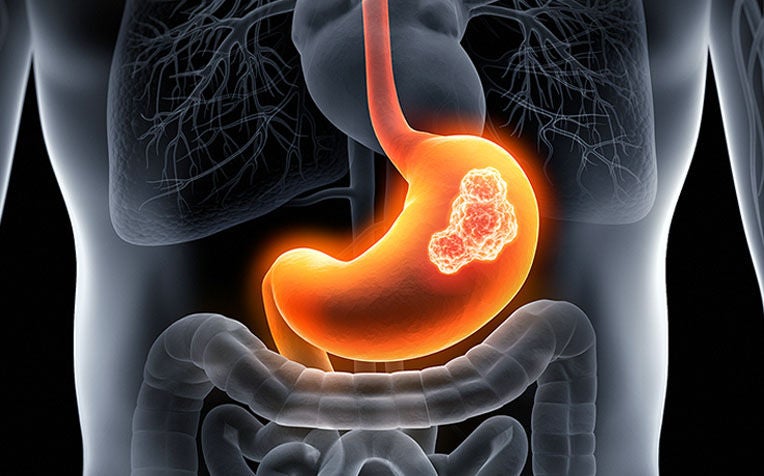
Chronic gastric problems puts one at high risk of developing stomach cancer (also known as gastric cancer).
Do not ignore the persistent belching, pain or discomfort in the upper abdomen, or bloated feeling after a light meal. These general symptoms could mean poor digestion or point to something more serious like stomach cancer.
What is stomach cancer (gastric cancer)?
In Singapore, stomach cancer or gastric cancer is the 8th most common cancer in males and 10th most common cancer in females. It more commonly occurs in men and individuals aged between 50 and 70 years old, and is more common among the Chinese compared to Malays and Indians.
Stomach cancer (gastric cancer) can affect any part of the stomach. It forms when cells in the stomach mutate in a way that cause them to grow and divide abnormally causing an ulcer or a mass to form within the stomach.
The mass or tumour can eventually spread through the entire wall of the stomach and spread to other parts of the body.
The good news is early stage stomach cancer is curable. Survival rate is as high as 80 per cent, but drops to 10 per cent at the advanced stage.
4 Types of stomach cancer
The types of stomach cancer are classified by cell type and where the cancer originates.
1. Adenocarcinoma
This is the most common stomach cancer, which accounts for 90-95% of stomach cancers. Adenocarcinoma starts in the glandular cells of the stomach lining. It can also be classified based on how it looks under the microscope – intestinal and diffuse subtypes. Diffuse adenocarcinomas tend to grow and spread more aggressively and are harder to treat.
2. Gastrointestinal stromal tumours (GIST)
GIST is a rare type of soft tissue sarcoma, which forms in the interstitial cells of Cajal (cells in the gastrointestinal tract) and other digestive organs.
3. Gastric lymphoma
Gastric lymphoma is a cancer of the immune system that forms in the stomach wall. They can be mucosa-associated lymphoid tissue (MALT) gastric lymphoma or diffuse large B-cell lymphoma of the stomach.
4. Neuroendocrine tumours or carcinoid tumours
This type of stomach cancer starts in the neuroendocrine cells, nerve-like and hormone-producing cells of the stomach.
Risk factors for stomach cancer
While the exact cause of stomach cancer is unknown, there are several risk factors including:
- A chronic infection by a bacteria called helicobacter pylori
- Gastroesophageal reflux disease
- A diet high in salted or preserved (cured/smoked/pickled) foods
- A diet low in fruits and vegetables
- Smoking and alcohol raises a person's risk of stomach cancer by 2.5 times
- Family history of stomach cancer or hereditary stomach polyps
- Hereditary syndromes such as familial adenomatous polyposis (FAP), Li-Fraumeni syndrome, hereditary nonpolyposis colorectal cancer (HNPCC) and Peutz-Jeghers syndrome
- Medical conditions that may contribute to stomach cancer such as:
- Anaemia (megaloblastic anaemia and pernicious anaemia)
- Previous stomach operation with partial removal of the stomach (gastrectomy)
- A stomach disorder called atrophic gastritis, which results in lower than normal production of digestive juices
- Stomach polyps
These risk factors are more commonly seen in people who have stomach cancer.
Having one or more of these risk factors does not mean that you will develop stomach cancer.
Stomach cancer may still develop in patients with none of the above risk factors.
5 Ways to lower risk of stomach cancer
Ways to prevent stomach cancer include:
- Eat a healthy diet that includes plenty of fruits and vegetables. Vitamin A and C, in particular, appear to lower the risk of stomach cancer.
- Consume less salted and preserved foods.
- Consume less smoked, preserved and cured meats like bacon, ham and bak kua.
- Avoid smoking and inhaling second-hand smoke.
- Exercise regularly and maintain a healthy weight. Lose weight if you are obese (Asians should target a BMI between 18.5 and 22.9kg/m2.
Stomach cancer symptoms
It takes many years for the cancer to develop and before symptoms are felt. Stomach cancer is hard to detect because symptoms are often non-specific, and in the early stages absent or very mild.
They could also be similar to those of peptic ulcer diseases (PUD) or gastritis.
Stomach cancer symptoms include:
- Persistent indigestion and a burning sensation after meals (heartburn)
- Bloated feeling after meals
- Upper abdominal discomfort or pain after a meal
- Early feeling of fullness despite a small meal
- Loss of appetite
- Unexplained and unintentional weight loss
- Nausea or vomiting
- Blood in stools or black tarry stools
When stomach cancer is more advanced it may be possible for a healthcare professional to feel a mass in the stomach.
Stomach cancer diagnosis
To know if stomach cancer is present
Tests and procedures used to diagnose stomach cancer include:
1. Upper endoscopy or gastroscopy

During this procedure, an endoscope (a thin fibre-optic tube containing a small camera) is passed through the mouth and down the throat to check for abnormal areas in the oesophagus, stomach and duodenum.
2. Biopsy
If any suspicious areas are discovered during the endoscopy, a tissue sample may be taken and sent to the lab for testing and analysis.
3. Barium meal X-ray
A liquid containing barium will be given to the patient for consumption, which will show up on x-rays, so that abnormalities in the oesophagus and stomach can be detected.
4. Faecal occult blood test (FOBT)
A lab test performed to determine the presence or absence of hidden (occult) blood in the stool.
If stomach cancer is detected
If stomach cancer is diagnosed, further tests may be required to determine if the cancer has spread and to determine the stage of the cancer. Some of the tests include:
1. Computerised Tomography (CT) Scan
A CT scan is a type of scan where x-ray beams are rotated around the body to produce a series of x-ray images photographed from different angles.
A CT scan is able to show the stomach clearly to confirm the location of the cancer. This test can also be used to look for cancer that has spread to the lymph nodes, liver or abdomen.
2. Positron Emission Tomography (PET) Scan
Positron Emission Tomography (PET) scan uses radiation to produce 3-D images of the body. However, due to the unique characteristics of stomach cancer, a PET scan may not be able to detect certain types of stomach cancer.
3. Exploratory surgery
Exploratory surgery may be recommended to look for signs that the cancer has spread beyond the stomach. This is usually performed laparoscopically (via key-hole surgery), where several small incisions are made and a special camera is inserted into the abdominal cavity to check for the spread of the cancer.
Treatment for stomach cancer
Treatment for stomach cancer depends on the following factors:
- Size, location, and extent of the tumour
- Stage of the disease when the cancer is found
- Patient’s general state of health
The main and only curative treatment for stomach cancer is surgery. However, chemotherapy and radiotherapy may also be required for some patients.
Endoscopic resection may be possible for very early cancers confined to the mucosa.
In advanced stage disease, chemotherapy is generally used in combination with surgery, and radiotherapy may also be administered.
An individual with cancer should be assessed by a specialist to determine which treatment is best suited for the person.
1. Surgery
Surgery typically offers the best chance to cure stomach cancer. The type of surgery, also known as a gastrectomy, varies based on the stage of the cancer.
- Upper endoscopy
Used to diagnose stomach cancer, an upper endoscopy can also be used to treat early stomach cancer limited in spread to the stomach’s uppermost layers.
As a part of this procedure an endoscopic submucosal dissection or endoscopic mucosal resection is performed, and the tumour is resected from the stomach and removed through the mouth.
When the cancer is more advanced, gastrectomy, or removal of the stomach is the recommended surgery.
- Partial or subtotal gastrectomy
This procedure involves the removal of a part of the stomach. After a partial gastrectomy, the surgeon will connect the remaining portion of the stomach to the oesophagusor the small intestine, depending on which part of the stomach was removed.
- Total gastrectomy
The surgeon may remove the entire stomach if the cancer is located in the middle of the stomach.
The lymph nodes near the stomach and surrounding tissue will be removed, and sometimes the spleen may need to be removed as well.
After a total gastrectomy, the surgeon will connect theoesophagus directly to the small intestine.
2. Chemotherapy
Doctors may recommend chemotherapy prior to surgery to shrink large tumours as well as after surgery to kill off any remaining cancer cells and improve the chance of cure.
Recent research carried out at Duke-NUS identified three subtypes of gastric adenocarcinomas - the most common type of stomach cancer. Each subtype had different genetic abnormalities and was found to respond differently to treatments in the laboratory.
Published in Gastroenterology, this study showed that the metabolic subtype was the most sensitive to 5-fluorouracil (5-FU) which is commonly used to treat gastric cancers.
The proliferative subtype of adenocarcinoma was less sensitive to 5-FU treatment.
The mesenchymal subtype seemed to be more sensitive to drugs targeting the PI3K-AKT-mTOR process which is commonly abnormal in cancers.
3. Radiotherapy
Doctors may include radiotherapy to shrink an advanced tumour or prevent gastric cancer from returning after surgery.
4. Targeted therapy
Targeted drug treatments work by blocking specific weaknesses present within cancer cells, causing the cancer cells to die. Targeted drug therapy is usually combined with chemotherapy for treating advanced or recurrent stomach cancer.
5. Immunotherapy
Immunotherapy is a drug treatment that helps a patient’s immune system fight cancer. Immunotherapy may be recommended if the stomach cancer is advanced, recurs or spreads to other parts of the body.
Tips to cope with stomach cancer treatment
1. Good nutrition
Many patients with stomach cancer (gastric cancer) lose a lot of weight. It is important for them to eat well as building up to a nearly normal weight can aid recovery.
Cancer and its treatments can cause a loss of appetite. Advice from a dietician to learn more about possible dietary changes will be helpful after stomach surgery.
2. Strong support
Supportive care to help people and their families to cope with cancer and its treatment should begin once cancer is suspected. Patients do not need to struggle with the illness alone.
Useful support services include the Medical Social Service Department of the hospital where treatment is done, and cancer support groups.
Ref: I23 (ed)
Related articles:
10 Most Common Cancers in Singapore (for Men and Women)
Colorectal Cancer: 8 Ways to Lower Your Risk
Breast Cancer: What Puts You at Risk
Prostate Cancer: All You Need to Know


Stay Healthy the Easy Way
Get verified health advice, offers and more.

Follow HealthXchange

