






1. As soon as a burn occurs, it should be cooled with running water for at least 15 minutes.
2. A minor first-degree burn can be treated at home with an antibiotic ointment. Treatment for a second-degree burn may include occlusive dressing, wound debridement, excision and skin grafting. For severe third-degree burns, treatment would be prologned as it can likely entail scar management rehabilitation, which can take between 18 months to two years for healing.
3. The to do's for burns and scalds include:
- Do stay calm
- Do place the affected area under cold running water for at least 15mins
- If there are constricting items around the affected area such as a watch and belt, do remove them immediately.
- Do send the burn victim to the nearest hospital for medical attention
The don'ts for burns and scalds include:
- Don't panic
- Do not attempt to remove anything that is directly stuck to the burn
- Don't apply any lotion/ointment to the affected area
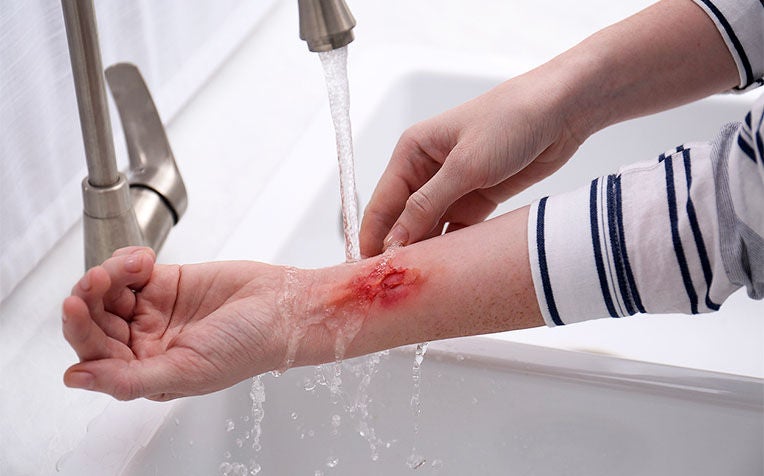
All burns , as far as possible, should be cooled with running water for at least 15 minutes.
The size and depth of the burn determine its treatment and management.
All burns, as far as possible, should be cooled with running water for at least 15 minutes, before medical help arrives.
Treat different degree burns differently
A minor first-degree burn typically is treated at home with the application of an antibiotic ointment from a home emergency kit.
In the case of a major second-degree burn, treatment options include occlusive dressing (Air- and water-tight dressing), and surgical interventions. The latter includes wound debridement (removal of non-living tissue from wound), excision (surgical removal of part or all of the non-living tissue) and skin grafting.
Severe third-degree burns would definitely require prolonged treatment. This is because one of the major post-burns complication is hypertrophic scarring (usually slightly raised and occurs within the initial area of the wound).
In view of this, patients often have to be on scar management rehabilitation involving skin grafting and scar therapy, and it can take between 18 months and two years to heal. Patients with burns that extend over a joint will require occupational and physical therapy too.
Watch the video!
“There is a team of doctors at SGH exploring a newer occlusive Biobrane dressing for burn patients. This new intervention can provide faster healing, resulting in better rehabilitation outcomes and a shorter hospital stay,” says Ms Pamela Ng, Senior Occupational Therapist fom the Department of Occupational Therapy at Singapore General Hospital (SGH), a member of the SingHealth group.
“Because of the pain associated with burns, patients may restrict their movements, but they should be encouraged to return to school or work, and their normal daily activities as soon as possible,” she added.
Do's and don'ts for burns and scalds
Do's | Don'ts |
|---|---|
| |
| |
|
|
|
 Stay calm
 Panic
PanicAbout different degree burns, common causes and symptoms
There are many different types of burn injuries, and they are classified according to the source of the injury and the extent of skin damage.
Thermal
These are caused by fire, explosions, steam, hot objects, hot liquids, etc.
- Flash: Caused by explosions from gas or flammable liquids, thermal radiation.
- Flame: Caused by exposure to prolonged and intense heat, such as a fire.
- Scald: Caused by contact with hot liquids, such as water, oil. A scald is the most common type of burn injury in children and older adults.
- Contact: Caused by contact with heated materials such as metals, glass or plastic.
Chemical
As a result of coming into contact with strong acids or alkaline substances.
Electrical
Caused by electrical sources.
Burns are described as first-degree, second-degree or third-degree, depending on the extent of damage to the skin:
Superficial (first-degree) burn
This involves the epidermis or top layer of the skin and is erythematous (red and inflamed), painful, and dry.
Superficial partial thickness (superficial second-degree) burn
A second-degree burn affects the epidermis and part of the underlying dermis and has clear blisters and wet, erythematous skin. It blanches (skin appears paler than usual) and is painful when touched and generally does not cause scarring.
Deep partial thickness (deep second-degree) burn
This second-degree burn affects the deeper layers of the dermis, and appears white in colour. It does not blanch when touched and often results in scarring.
Full thickness (third-degree) burn
This is the most severe of burn injuries. All skin layers, including the underlying subcutaneous fat, are destroyed. This burn is dark brown or tan in colour and has a leathery feel. It is not sensitive to touch.
Burns and scalds are common but easily preventable
Most burn injuries occur in the home and are accidental in nature. Women and children are more likely to fall victim to a burn injury in the kitchen, while men may suffer a burn injury at the workplace.
How to prevent burns and scalds in children
“Prevention efforts can significantly lower the incidence of burns, especially in children,” adds Ms Ng. What parents can do includes:
Keep your child out of the kitchen as far as possible.
Before you put your baby or toddler in the bath, test the temperature of the water using your elbow.
Keep matches, lighters and lit candles out of young children's sight and reach.
Keep hot drinks away from young children.
How to prevent burns and scalds in people with diabetes (diabetics)
“People with diabetes (diabetics) experiencing diabetic neuropathy may develop burns from soaking their feet in hot water, and using a warming device such as a heater,” advises Ms Ng. Here's what they can do to prevent burns and scalds:
Before going into the bath, test the water temperature with your elbow.
Avoid using a contact warming device such as a heater or a hot pack.
Ref: I23


Related Articles

Stay Healthy the Easy Way
Get trusted health advice, offers and more.

Follow HealthXchange

