






Infants with early childhood caries have a high risk of developing caries in their adult teeth.
Take your child to the dentist from the age of one, recommends the Infant Oral Health Clinic at the National Dental Centre of Singapore (NDCS), a member of the SingHealth group.
How do I care for my child’s teeth?
What can parents do?
Parents play an important role in establishing good oral and dietary habits early, seeking dental care early, and helping to shape positive experiences during dental visits.
How do I care for my child’s teeth?
A child’s gap-tooth smile may look cute, but a mouth full of decaying milk teeth is no laughing matter. About 40 per cent of preschool children in Singapore show severe tooth decay, caused by a bacterial infection known as early childhood caries. This puts them at high risk of developing caries even when their milk teeth have been replaced with adult teeth. To address this oral health problem, paediatric dentists at the Paediatric Dentistry Unit of National Dental Centre Singapore (NDCS), a member of the SingHealth Group set up a clinic dedicated to children and their parents. The Infant Oral Health Clinic at NDCS is the first in Singapore to offer a comprehensive programme which identifies caries risk, monitors oral development, and educates parents and caregivers on caring for their infants’ teeth.
Typically, the first tooth comes in only at six to 12 months of age. You can start cleaning your child’s gums from birth with a damp cloth or a soft infant brush twice a day. This helps to massage the gums and also prepare them for twice-daily tooth brushing that should start when the first tooth erupts. Your dentist can advise you on the appropriate amount of fluoridated toothpaste to use. Prolonged or on-demand night time drinking of milk from a bottle may cause an increase in tooth decay. We encourage you to reduce sweet food and beverage intake to prevent tooth decay.
Care for milk teeth
Early childhood caries can be spread to the child through saliva from the mother or caregiver who has untreated dental disease. This can happen with sharing of food or cutlery.
Dr Tan Wee Kiat, Senior Consultant, Paediatric Dentistry Unit, NDCS, said that there is a misconception that baby or milk teeth can be left to decay as they will eventually fall out. Of those preschoolers who have high levels of decay, 90 per cent of the decay is untreated, which implies that parents are not taking their children to dentists for regular checkups. This may, in part, be due to the fact that pre-schoolers do not have access to a school-based dental programme, unlike older children in primary schools.
When should I bring my child for the first dental visit?
American Academy of Pediatric Dentistry now recommends that a child’s first visit to the dentist should be at age one or shortly after the first tooth appears. Going to the dentist only when the child has dental problems may cause unnecessary anxiety which could result in a unpleasant visit. Said Dr Tan: “It is easier to acclimatise the child to dental treatment when we can start with non-invasive procedures.”
Early dental visits are important and beneficial for children with medical conditions (e.g. cardiac conditions, blood disorders), or behavioural conditions (e.g. autism).
What to expect during the first visit?
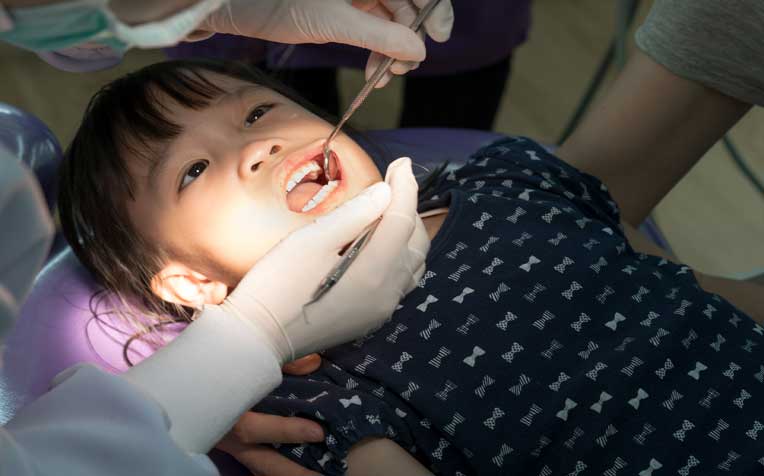
Inform your dentist of any medical history or allergies your child has. Your child’s dentist will ask for some dental history before introducing your child to the dental chair and instruments in a simple way. Your child’s dentist will:
- Perform a checkup of your child’s mouth and assess for any problems.
- Teach your child how to brush his/ her teeth as well as how you can help supervise their brushing.
- Give your child tailored preventive advice on his/her diet and habits, such as intake of sweet/sticky food and, weaning off breastfeeding and milk bottle, thumb sucking etc.
- Recommend the type of toothpastes and toothbrush for your child.
If your child has deep cavities (holes), x-rays may be necessary for better assessment of the teeth.
How should I prepare my child for this visit?
Some tips:
- Book an appointment that your child is unlikely to be tired and give ample time for the appointment.
- Avoid giving food or flavoured drinks to your child while waiting to be seen by the dentist.
- Familiarise your child with the dental clinic by reading a book on dental visits or bring him/her along when a family member goes for a dental check-up.
- “Rehearse and play dentist” with a torchlight and play teeth counting with the child. Watching online ‘Children’s dental visits’ videos may help with the role play.
- Avoid the use of suggestive words like pain, worry, injection, pulling teeth, drilling etc. especially when you are trying to discipline your child.
- Use simple terms but avoid being too detailed. Our friendly dentists and nurses are trained to speak to your child in simple reassuring words.
- Parents should avoid sharing their own fears to their child. Bring along another relative or sibling who can help the child feel at ease or hold the child if they are very anxious.
- You can plan something fun after the appointment e.g. to the playground but avoid bribery/threats to get them to cooperate.
- The dentist is here to help your child and is not “the bad guy”; avoid portraying this image to your child!
Tips for children with special needs
Children with special needs may not have the ability to understand, assume responsibility for, or cooperate with preventive oral health practices. Hence, they have a greater risk of oral and dental diseases. However, there are things that you can do to help your child the best way you can:
Preparation and first visit
- Educate your child with videos, books, songs or role play on the dental visit.
- Let the dental team know in advance if your child has special needs.
- Ask for a visit at the beginning or in the earlier part of the day.
- Your child is best accompanied by parents or guardians.
- Bring along their own toothbrush for the first visit.
- You may wish to bring along an item that comforts your child’s anxiety e.g. toy, blankets, music.
- It may take more than one visit before your child allows the dentist to have a look at their teeth.
- Sometimes, if your child is less cooperative during examination, parent’s help may be required.
- Share past experiences with the dental staff.
If your child needs treatment
- Your child may experience unusual sensations or tastes, and they may respond by making anxious noises or actions.
- Do not be alarmed, our dentists and nurses are trained in caring for children with special needs and will take the utmost care.
- If it is not possible to do an examination or treatment for your child on the chair, we may need to reschedule your child for general anaesthesia later.
- Your child may not be able to express pain very well. Hence, it is important to look out for unexplained changes in behaviour e.g. not sleeping well, biting on things or avoiding food.
Choosing the right dental professional
- The age of the child.
- It is difficult to get young children to cooperate during dental check-ups.
- The dental professional has to be experienced in assessing a child’s oral health quicklyy.
- The type of care required.
- The care offered by dental professionals differs and the choice of professional depends on the complexity of the child’s oral health needs.
- There are oral health therapists, general practitioners and paediatric dentists.
- The treatment needs of the child.
- If the child has existing medical conditions, further assessment may be required by a specialist before starting treatment.
- If the child has existing medical conditions, further assessment may be required by a specialist before starting treatment.
- Being comfortable with the dentist.
- If the child feels at ease, half the struggle is over, and the dental experience will be more pleasant for both parent and child.
- If the child feels at ease, half the struggle is over, and the dental experience will be more pleasant for both parent and child.
- Find out about the professional who will treat your child.
- Singapore Dental Council provides information on qualifications and registration status of dentists in Singapore.
Ref: F26
Contributed by

Stay Healthy the Easy Way
Get verified health advice, offers and more.

Follow HealthXchange

